New York finalized its updated RGGI regulations on August 5, and New Jersey followed two days later with a formal filing to align its CO2 Budget Trading Program with the 2025 Model Rule. Both moves keep the region on track for January 1, 2027 implementation of the program amendments agreed upon during the Third Program Review, which kicked off in 2021 and concluded July 2025. Both also arrive as the now 11-state region (Virginia re-joined as of July 1, 2026) grapples with high allowances prices around USD 40 per short ton, far exceeding RGGI soft price ceiling levels.
On August 7, New Jersey's DEP, Board of Public Utilities, and Economic Development Authority jointly submitted a proposal to the Office of Administrative Law to amend the state's CO2 Budget Trading rules, with publication expected in the September New Jersey Register. The filing runs alongside Governor Sherrill's Executive Order 1, which has already pushed a second round of Residential Universal Bill Credits and directed DEP, BPU, and EDA to report back on how RGGI proceeds can be used for ratepayer relief. New York's DEC and NYSERDA, meanwhile, finalized their own regulations on August 5 following a comment period that closed in February, framing the tightened cap explicitly around “affordable and effective emissions reductions through 2037.”
RGGI Auction Prices
RGGI's quarterly auction price has more than quadrupled since early 2021, when the member states were looking to kick off a Program Review to expand the program and align it with ambitious power sector decarbonization targets embedded in state laws. RGGI states were expecting to greatly expand renewable electricity generation, including bets on significant offshore wind capacity backed by procurement authority and REC markets.
The Program Review process had to contend with increased uncertainty around electricity demand growth to account for data centers and electrification (after years of flat loads), plus the Trump Administration rolling back support for renewables and offshore wind and concerns over costs to ratepayers. Also, Virginia dropped out of RGGI after 2023 compliance and did not participate in any of the Program Review modeling, only to re-join the market in haste in mid-2026 following the election of Governor Spanberger (D) in 2025. Meanwhile, Pennsylvania has abandoned efforts to participate in RGGI.
The chart below shows the clearing price for RGGI auctions beginning in February 2021 through June 2026. Auctions which triggered the release of Cost Containment Reserve (CCR) allowances into the market are indicated. There is a fixed CCR quantity each year, tied to an escalating trigger price; once the pool is exhausted for a particular year, it is not replenished until the following year. Therefore, the CCR is a soft price ceiling. The latest auction clearing price of USD 35 from June 2026 is far above the 2026 CCR trigger price of USD 18.22.
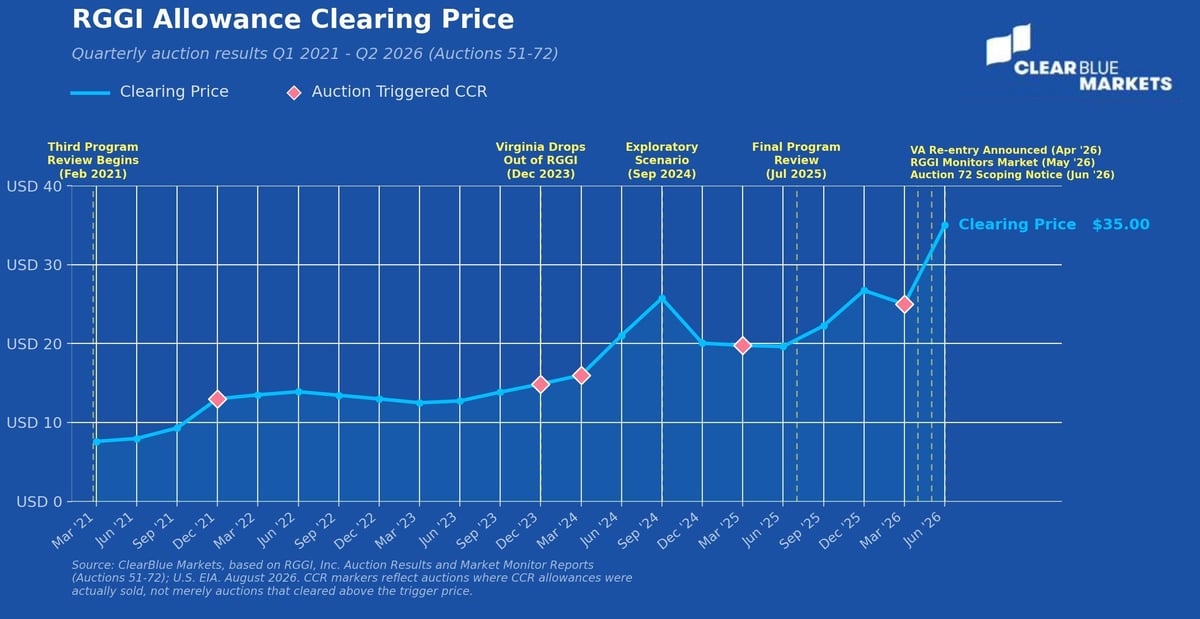
The upward price trajectory reflects the changing power market dynamics, tightening RGGI balances and allowance bank draws, the full depletion of the CCR supply, and most recently the re-entry of Virginia as of July 2026.
At the conclusion of the Third Program Review in July 2025, RGGI planned to begin another review no later than 2028. The recent price run-up had caused concern. In May 2026, a notice was released, "RGGI States Monitoring the Market," advising that a “sustained period of elevated auction prices” would not meet the program objectives and “may require renewed consideration of improvements.” With a lack of specifics or a concrete timetable, it failed to have much effect on the June 2026 auction price. After the results for that auction, RGGI released another statement: "Following this auction, the RGGI states intend to begin a scoping process to consider further targeted measures to continue to achieve reliable, clean electricity supply at affordable prices for consumers." With options limited outside of a Program Review, RGGI has subsequently increased the September auction quantity, and pledged to increase the December auction quantity with set-aside allowances.
See the Virginia DEQ website for more information on its regulatory process for RGGI. Virginia, a large emitter compared to the rest of the RGGI region, finalized a rule based on the current program structure for 2H 2026 only. The re-entry has not been smooth, as emitters in Virginia started accruing an obligation July 1, but need to wait until September to procure auction supply. The Virginia half-year cap does not take into account that emissions are higher in the 2H of the year, nor does it account for rising emissions in the state since its RGGI exit after 2023. The additional CCR supply Virginia introduces in 2026 is too small to meaningfully contain pricing. Note, however, that Virginia has yet to complete its rulemaking for 2027+; this must be finalized in time for January 1, 2027 implementation. According to the DEQ, “The base budget for Virginia for 2027 will be determined during the development of a second regulatory action required by HB 29 in alignment with the latest model rule and outcomes from the Third RGGI Program Review.” Therefore, this rulemaking could present another opportunity to smooth the state’s re-entry.
The Program Amendments Greatly Expand Cost Containment
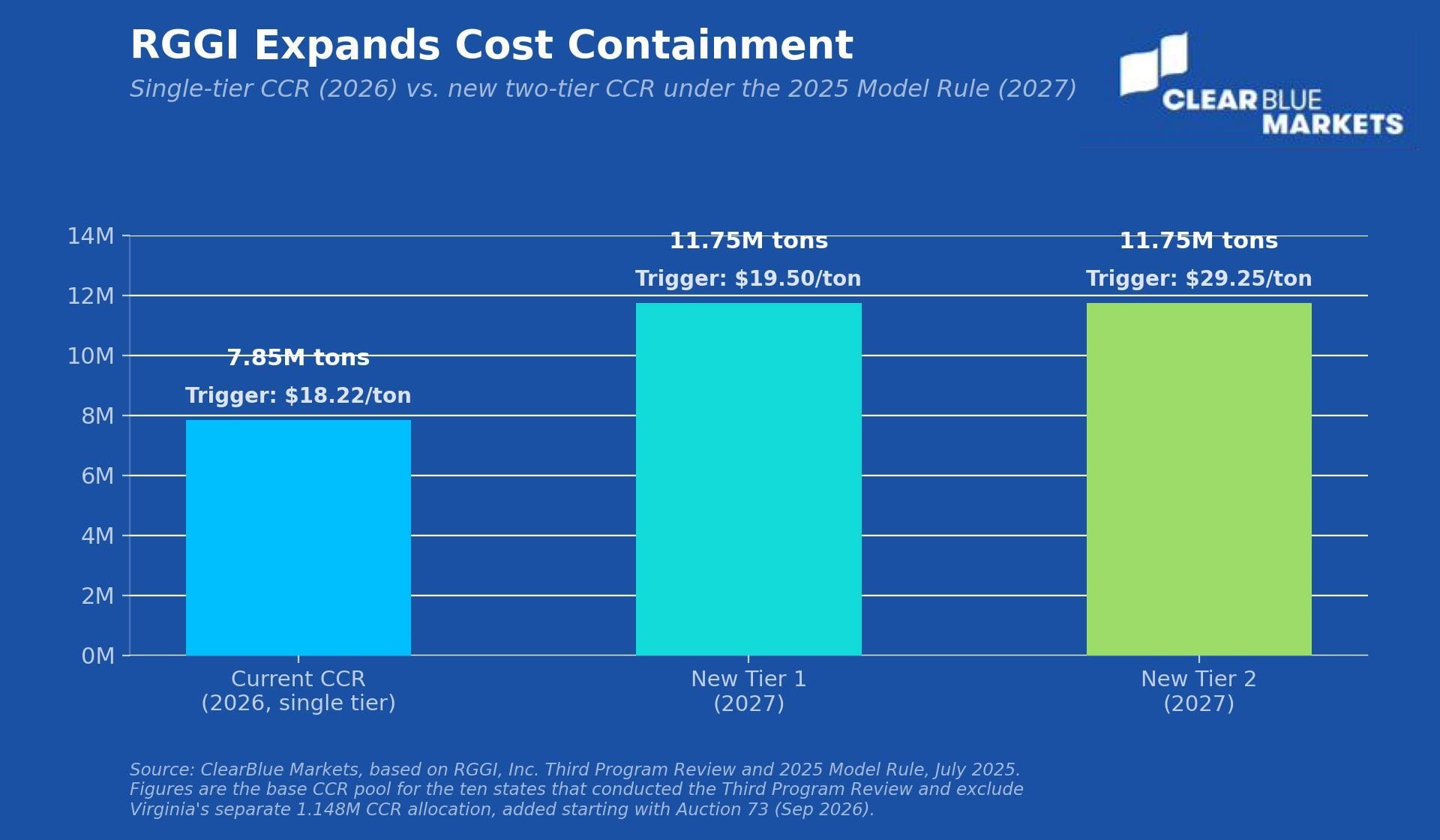
Taking affordability concerns into account, the updated Model Rule should provide a degree of near-term relief for the states. The Third Program Review splits the CCR into two tiers, roughly 11.75 million allowances each, triggering at $19.50 and $29.25, respectively in 2027. This is a materially larger pool of supply, surplus to the cap, than today's single-tier, roughly 7.85 million-allowance CCR (ex Virginia).
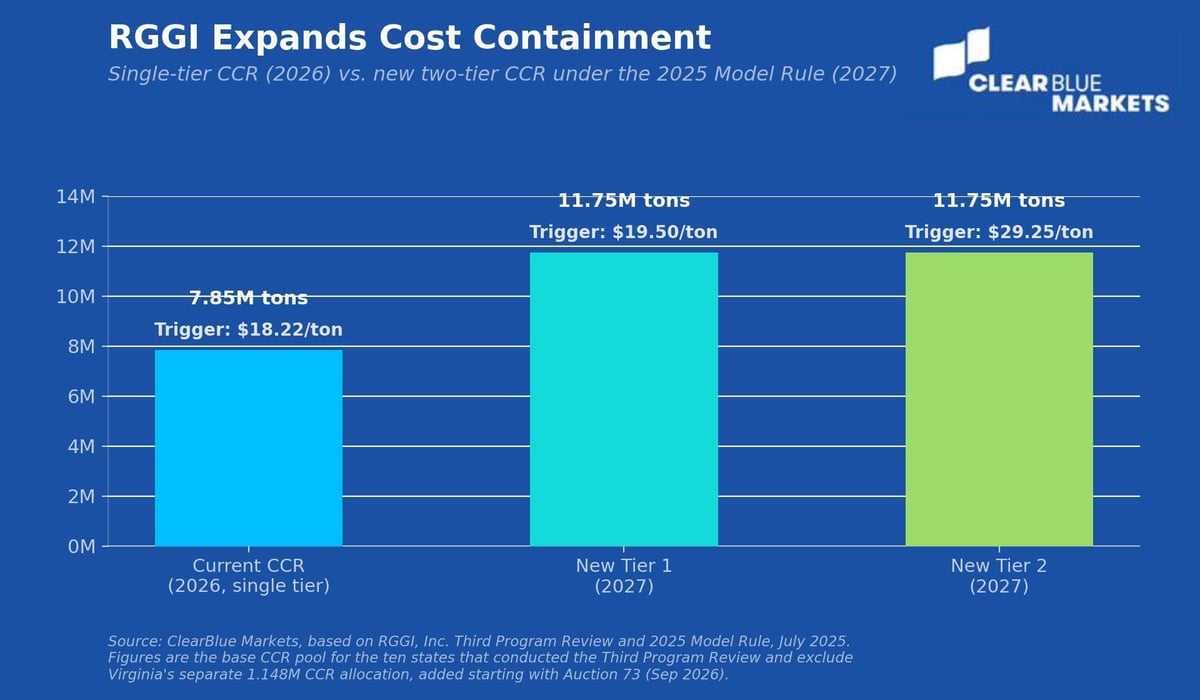
ClearBlue’s RGGI Supply & Demand modeling, available on the Vantage platform, calls for an annual bank build in 2027 with the higher CCR supply. This can help moderate prices. Therefore, rejecting the 2025 Model Rule will not address affordability concerns.
Over the coming months, market players will continue to track states’ adoption of the 2025 Model Rule in time for 2027 implementation, the regulatory process in Virginia, any other tweaks to 2026 auction supply and the potential for an early start to the next Program Review.
RELATED COVERAGE ON CLEARBLUE MARKETS' VANTAGE PLATFORM
ClearBlue Markets' analyst team has been following these developments closely and keeping clients informed via Vantage, our carbon intelligence platform:
-
Live Update — RGGI to Introduce Additional Allowances at September & December Auctions (July 14, 2026)
-
RGGI Auction #72 Results (June 5, 2026)
-
RGGI Supply & Demand Model, June 2026 update (June 1, 2026)
-
Live Update — Virginia Officially Rejoins RGGI (April 29, 2026)
-
Live Update — Impact on RGGI of Virginia Re-entry (April 7, 2026)
For information about our Market Intelligence subscription services, including allowance price forecasts, auction analysis, and RGGI advisory support,