
On April 8, 2026, the Calgary Carbon Club hosted a sold-out event to discuss one of the most critical topics in the Canadian energy sector: the Canada-Alberta MOU and ongoing federal program review. The event was sponsored by ClearBlue Markets to celebrate the opening of their new Calgary office, and brought together industry stakeholders, consultants, and market participants.
To make sense of the current landscape, a panel of experts was invited to look beyond speculation and focus on observed market behaviors, industry reactions, and long-term forecasts.
Natalie Giglio, ClearBlue’s Head of Business Development for North America, moderated the discussion. She set the stage by noting that while the market had hoped for a finalized carbon pricing agreement by the April 1 deadline, this was not to be the case. Nonetheless, the industry is seeing significant progress on the Memorandum of Understanding (MOU) deliverables.
The panel featured Nico Curtis, Manager Market Analysis and Canadian markets lead at ClearBlue; Chelsea Erhardt, a seasoned environmental commodities trader at Traxys; and Scott Volk, Director of Emissions and Innovation at Tourmaline.
Here is a comprehensive summary of the panel’s insights.
Market Dynamics and the "Price of Uncertainty"
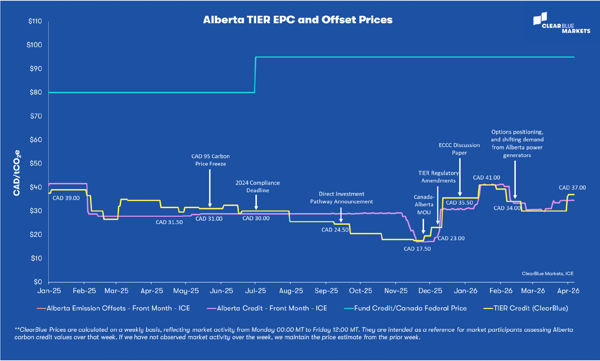
To ground the conversation, Nico Curtis provided a detailed overview of the Alberta TIER market's recent volatility. Over the past year, the market has seen dramatic swings: TIER credit prices started 2025 around $39, plummeted to $17 just before the MOU announcement in November, rallied to a peak of $41, and have recently settled in the $37 range.
2025/26 TIER Pricing Dynamics
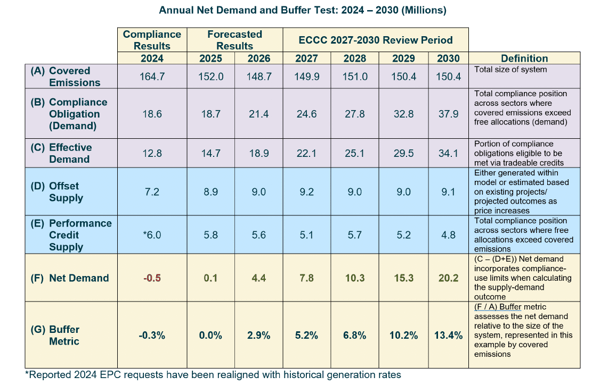
Curtis also presented ClearBlue's supply and demand modeling out to 2030, highlighting that while the program could go structurally short by 2030. His slides on the Annual Net Demand and Buffer Tests showed that the market could face 20 million credits in annual demand by the end of the decade, potentially depleting the entire surplus bank of credits.
Annual Net Demand & Buffer Test
Chelsea Erhardt offered a trader's perspective on these price swings. "The price of Alberta in the last 6 months or even last year is not necessarily a reflection of the oversupplied fundamentals," she explained. "I think it's just been a measure of the fear and uncertainty that has persisted in the market". Erhardt pointed out that without a well-developed options market to buy puts, investors are exposed to full downside risk, making capital deployment difficult when existential risks loom over the program.
Looking globally, Erhardt noted that the current macro-environment is vastly different from the "green revolution" of 2021. Today, affordability and high energy prices dominate the conversation. Regulators in California and Europe have also had to step in to prevent carbon prices from rocketing too fast, emphasizing the need to keep the public on board.
A Collaborative Shift in Government Tone
Despite the market uncertainty, Scott Volk observed a highly encouraging development: a major shift in the tone between the provincial and federal governments. "There is a major tone shift suggesting the two governments are pointed in the same direction," Volk noted.
He recounted seeing Natural Resources Minister Jonathan Wilkinson and Alberta Premier Danielle Smith working together collaboratively, driven by a shared focus on addressing affordability and achieving "economic sovereignty". Volk pointed out that both governments are now proposing massive production increases, such as doubling natural gas production in Canada and expanding Alberta's oil and gas output.
This marks a departure from times when carbon pricing was sometimes viewed as a tool to keep resources in the ground. "Alberta's carbon pricing was designed on this concept of, let's make sure that the primary industries remain really competitive, but let's have a modest amount of carbon price with competitiveness at top of mind," Volk explained.
The TIER Oversupply: A Success Story, Not a Failure
A recurring theme was the perception of Alberta's large bank of surplus credits. While some view an oversupplied market negatively, the panel argued it is actually a testament to the policy's success.
"The oversupply also means that we did all these things so much faster than we expected," Volk argued. "We transitioned off coal so much faster than we expected. We did the methane protocol, and we hit our 45% methane reduction target so much faster than expected. As Albertans, we should be relatively proud of [that]".
Erhardt strongly agreed, noting that a market with a big bank is vastly superior to a market with no bank. She cited Washington's cap-and-invest program as an "absolute nightmare" for compliance entities who are forced to pay $70 USD a ton due to a lack of banked allowances. "We're blessed with this huge bank that we just need to create enough certainty so that we can manage the bank properly out to 2030," she added.
The Methane Equivalency Milestone
The panel spent significant time unpacking the recent Canada-Alberta agreement-in-principle on methane equivalency, a major MOU deliverable aimed at a 75% reduction target by 2035.
For the industry, the most critical aspect of this agreement is that it leaves offset programs intact. Volk expressed relief that the market mechanisms driving innovation have been preserved: "Pneumatic offset protocols and venting protocols look to be here for the long term. What a crazy concept that a protocol might make its whole lifetime and not be conquered by regulatory additionality".
Curtis echoed this sentiment, emphasizing that the agreement gives long-term certainty to offset developers, allowing them to confidently invest in projects through 2035. By validating the role of offsets, the governments are ensuring that capital continues to flow into emissions mitigation without unnecessarily harming the competitiveness of the energy sector.
The Bull Case: AI Data Centers and Power Generation
Perhaps the most forward-looking segment of the discussion centered on the massive, impending energy demand from AI data centers. Curtis highlighted this as one of the most interesting topics to watch right now, pointing to the potential for up to 20 gigawatts of data center load coming online in Alberta.
If the government can find the right "cost-competitive balance" by ensuring regulations don't dissuade investment, this behind-the-fence natural gas generation will create substantial, long-term compliance demand in the TIER market.
Volk confirmed that Tourmaline, as Canada's largest natural gas producer, is seeing incredible demand. "The amount of inbounds we get from data centers asking for natural gas is crazy," he shared. He referenced Premier Danielle Smith's vision for this sector: "The real opportunity of data centers is to export natural gas through ones and zeros and not through pipelines where we don't need to build the infrastructure".
While Erhardt acknowledged this as the definitive "bull case" for carbon demand, she cautioned that rocketing carbon prices might undermine the public and political support needed to maintain the program in an environment focused on affordability.
Free Markets vs. Stroke of Pen Risk
During the audience Q&A, the conversation turned to balancing affordability with the need to fund new, innovative decarbonization technologies. Volk stressed that pushing carbon pricing stringency too high on primary sectors only pushes capital into international jurisdictions.
When asked about predictability in carbon pricing, Volk did not hold back on the dangers of government intervention, often referred to as "stroke of pen risk".
"Predictability in a free market, from my perspective, is way easier to understand than what governments may or may not do four years from now," Volk stated. "The number of times a government has said they need to change carbon prices to make it more predictable is really comical to me". Erhardt agreed, emphasizing that the current goal should be securing a durable program that everyone buys into, rather than fixating on forcing a specific price point.
Looking Ahead
As Natalie Giglio wrapped up the panel, she asked the speakers for their final takeaways on this unique moment in time for Alberta's carbon market.
Chelsea Erhardt views the MOU as the foundation for the future. "As I see it, the MOU is going to provide the certainty to lay the groundwork for the next phase of the Alberta carbon market, kicking off a lot of trading and a lot of new relationships," she concluded.
Scott Volk remained highly optimistic about the collaborative efforts underway. "I believe that the MOU will set the policy and the direction for all of Canada, not just Alberta," he stated, noting that the sheer size of Alberta's market gives it foundational importance.
Finally, Nico Curtis highlighted the silver lining of the recent regulatory turbulence: market attention. "I think a big positive is the amount of conversation and interest around carbon markets that we've seen. It's putting carbon pricing in the spotlight," he said, hoping this momentum drives long-term investment into the province.
As the industry awaits the finalization of the MOU deliverables—including the highly anticipated carbon pricing equivalency agreement—one thing is clear: the path to decarbonization is complex, but with collaboration, transparency, and a functioning free market, Alberta is well-positioned to lead the charge.
***
Stay tuned for more discussion and analysis on this topic as the governments release additional information in the coming weeks and months.
In the meantime, if you would like to discuss what all of this means for your Canadian carbon markets strategy, or if you would like to know more about the services ClearBlue Markets provides for market participants globally, please get in touch.

