
With the first EU ETS2 auction a matter of weeks away, ClearBlue Markets hosted a webinar examining factors influencing pricing of ETS2, the EU's emissions trading system for buildings and road transport fuels. ETS2, when coupled with the existing EU ETS, is poised to expand carbon pricing economy-wide, similar to the North American WCI program, but is sensitive given its interaction with gasoline and diesel prices at the pump. Recall ETS2 was poised to begin in 2027, but was pushed to 2028, with early auctions scheduled to begin in January 2027.
Host Riham Wahba, Senior EU & UK Market Manager at ClearBlue Markets, began by saying that "the ETS2 early auctioning starts at the worst time" and that she doesn't "envy anyone working on the policy side."
Two things make the timing difficult. The first is political. Spain is holding a general election, the Council is due to agree its general approach in December, and France and Poland hold elections next year. 31% of the legislated 2027 auction volume comes to market in the first quarter. The second is the cost of living, with fuel prices and inflation high across the EU.
Political dates around the auctions
Riham grouped the political events around the auctions into three windows.
The first runs to mid-December. Spain holds its general election on Sunday 29 November, the Parliament's environment committee (ENVI) votes on 1 December, and the Council is due to agree its general approach on 11 December. A change in the leaning of Spain's government would affect its support for ETS2, even though Spain wrote to the Commission this week that ETS2 should not be touched. A Commission representative on the call said Spain approved the national law that transposes the ETS2 directive on Friday 20 November. That means Spain would not undo it unless a new government chose to.
The second window is the French election in April. Riham called it "a major sentiment overhang" and said it could also bring headline risk around how the auctions clear and how participants feel about them. Participation could thin, and it "wouldn't be an outlier to see some failing auctions" around that time.
The third falls late in the year, when Poland votes (an election is due by 11 November 2027). Poland is a vocal opponent of ETS2 because of what it costs its citizens, with a high dependence on fossil fuels for heating homes.
Any of the windows could also help ETS2, depending on the results. Polls and headlines currently lean to the right, and if the outcomes match them, "it wouldn't be positive," Riham said. If governments opposed to environmental regulation fail to gain ground, "it could be supportive for the start of ETS2 on time."
Where the Council stands
Riham called the Council "the most deciding element" in the decision-making process. Each change to ETS2 so far has come through another directive that was open at the time. The first delay, which the Council backed on 5 November 2025, was tied to the 2040 Climate Law. The current attempt is tied to the review of the original EU ETS, known as ETS1. The ETS1 program review could provide an opportune moment to reopen ETS2, with member states asking for a delay or negotiating a dilution, even though it has been said repeatedly that ETS2 should not be touched. In October, six member states asked for ETS2 to start in 2030 and Estonia asked for it to be scrapped. On 6 November, German Chancellor Friedrich Merz wrote that there should be no further changes.
ClearBlue Markets' analysts place the countries opposed to any delay at 38.6% of the EU population, above the 35% needed for a blocking minority, and the countries asking for a delay at 29.8%. They also note that the delay camp is where ETS2 is least ready, since five of the seven opposing states have not fully transposed. In their reading, Germany and France are the decisive voices. Germany supports ETS2 on time, in part because a delay would force it to recalibrate its national system. A right-wing government in France after the spring election might turn it from a supporter into an opponent.
Figure 1. Member states by position on delaying ETS2 and by transposition status
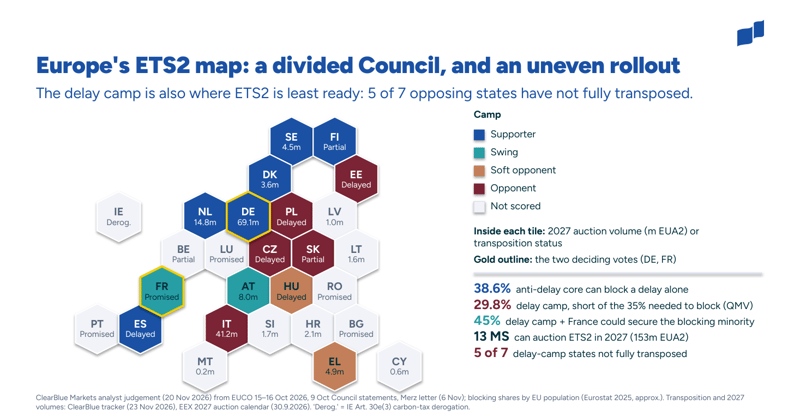
Source: ClearBlue Markets analyst judgement (20 November 2026), ClearBlue tracker (23 November 2026) and the European Energy Exchange (EEX) 2027 auction calendar. Shown as presented at the webinar on 24 November 2026. Spain's transposition status was updated during the session.
In the Parliament, the swing group is the European People's Party (EPP). On ClearBlue Markets' count, the parties on the right are 168 seats short of a majority for a delay and would need most of the EPP. The member states are likely to decide first, with the Parliament then asked to reopen the directive for any change.
The analysts suggest either a full transposition or a full delay would be preferable to a partial start. A partial start would mean amending the directive and the auction calendar several times, which "takes away the element of certainty around the auctioning and around the system structure."
Fuel prices before the first auction
Pump prices explain much of the political pressure. Using the European Commission's weekly fuel bulletin, Riham showed diesel at EUR 2.18 per litre in September, above every month of the 2022 energy crisis, when the peak was EUR 1.99. Diesel swung 40% over the year, against 31% in 2022, after two oil price shocks. Against their 2022 averages, petrol prices have risen most in Hungary (26%), Romania (15%) and France (13%).
Figure 2. EU diesel prices in 2026 against 2022 (EUR per litre)
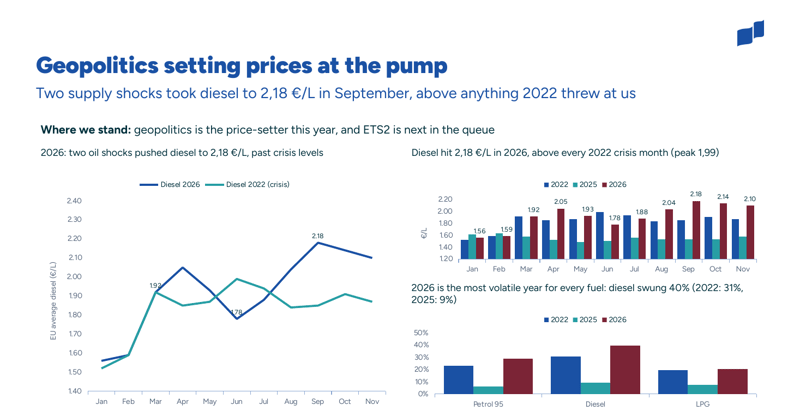
Source: European Commission weekly fuel bulletin, as presented in the ClearBlue Markets webinar on 24 November 2026.
A diesel tax set off the gilets jaunes protests in 2018, and in October yellow vest protesters were back on the streets of Paris. In July, 10 member states led by Italy and Poland asked for ETS2 to be rethought before its 2028 start.
ClearBlue Markets' scenarios put the ETS2 add-on at the pump between 7 and 22 cents per litre before VAT. At EUR 60 per tonne for an ETS2 allowance (EUA2), it adds 14 to 16 cents.
"All in all, we're seeing the pressure building for the case of delaying or diluting the ETS2," Riham said, "because of how it translates into cost of living and inflation." The Commission's autumn economic forecast expects inflation to stay high into 2027, at about 4% in the first quarter, which is also the quarter with the largest share of ETS2 auction volume.
Half of the member states have volumes in 2027
That pressure comes after ETS2 has already been delayed once. A one-year delay, linked to the 2040 Climate Law, moved the start of compliance to 1 January 2028 and came into force on 7 April 2026. Early auctions still begin in January 2027 so that buyers can hedge ahead of compliance, but only 13 member states can sell ETS2 allowances then, because the others have not fully transposed the directive. The 13 countries hold 153 million allowances on the 2027 EEX calendar.
Countries that have not fully transposed are due about two-thirds of the EUR 65 billion Social Climate Fund (SCF). Poland, the largest beneficiary with a 17.6% share, is delayed. France has promised to transpose, and its environment ministry is waiting for the result of the spring election before deciding how to proceed. Hungary is delayed as well, in a case of ideological pushback.
Italy is the reverse case. It has transposed and holds 41.2 million allowances on the calendar. "It would be selling in the market while [Italy is] politically opposing the start of ETS2," Riham said.
An uneven rollout creates uncertainty for early auctions
The uneven implementation of ETS2 across Member States raises questions about how the market will function during the early auctioning period.
Yehor Melakh, Senior Market Analyst at ClearBlue Markets, highlighted several aspects of the regulatory framework that warrant closer attention, particularly the Social Climate Fund (SCF), the price safeguard mechanism and the treatment of withheld national auction volumes.
Alongside national auction volumes, the 2027 auction calendar includes 140 million allowances allocated to the Social Climate Fund. With Member States progressing at different paces towards ETS2 implementation, the distribution and timing of allowance supply become particularly important when assessing the market balance. Unlike national auction volumes, SCF allowances are not withheld due to transposition delays, creating a potential mismatch between allowance supply and initial market demand.
Under the strengthened price safeguard, 40 million allowances can be released when the relevant price threshold is exceeded for two consecutive months. A second release within twelve months is possible if the Commission exercises its implementing power. The threshold of EUR 45 is expressed in 2020 prices and adjusted for inflation, bringing it to approximately EUR 60 in today's prices.
However, questions remain about how the safeguard would operate if participation in the early auctions remains limited, as additional allowance releases could potentially lead to oversupply in a market with a smaller initial demand base.
Another uncertainty concerns the timing of the reserve. In its communication of 27 November 2025, prior to the formal postponement of ETS2 to 2028, the Commission indicated that the safeguard could operate from the start of early auctioning.
However, the Market Stability Reserve is only established in 2028, while early auctions begin in January 2027. This raises the question of where the additional allowances would come from if the safeguard were triggered before the reserve is established.
Demand during 2027 will also depend on the extent to which companies begin hedging ahead of their first compliance obligations. Companies in Member States that have yet to transpose the relevant provisions could still enter the market in anticipation of future compliance, potentially influencing prices well before their countries begin auctioning.
Assessing different transposition scenarios
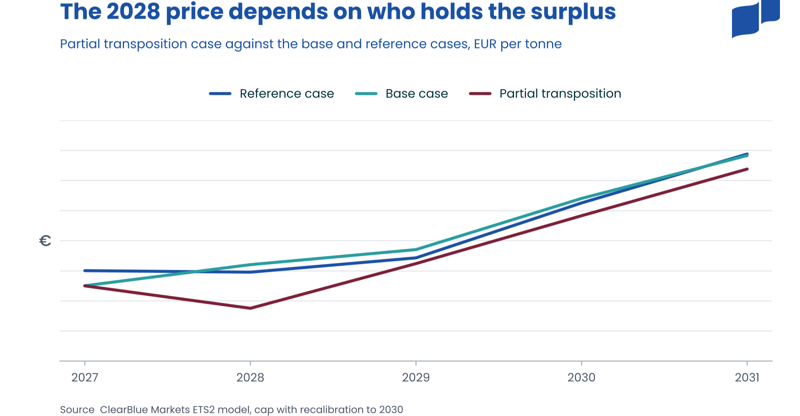
ClearBlue Markets examined three scenarios to assess the implications of different transposition timelines for ETS2 prices.
In the reference scenario, all 27 Member States participate from the start of early auctioning in 2027. This provides a benchmark for assessing how the market would develop under full implementation of the existing regulatory framework. Under this scenario, the price safeguard is expected to play an important role in mitigating upward price pressure during the first few years, before the reversal of front-loading and the declining cap contribute to market tightening from 2030 onwards.
The base case, representing ClearBlue Markets' central expectation, reflects the current auction calendar, with only 13 Member States auctioning in 2027, followed by full participation in 2028. The uneven rollout, combined with the absence of compliance obligations during early auctioning, creates downside risks for prices in 2027. However, lower prices during the early auctioning period do not necessarily translate into a more bearish outlook for subsequent years, given the interaction between auction supply and market stability mechanisms.
The third scenario examines the impact of a partial start in 2028, with only the 13 countries currently included in the auction calendar having compliance obligations and the remaining Member States joining in 2029.
While it could allow the system to begin on time, ClearBlue Markets' analysis suggests that it could create a significant imbalance between allowance supply and compliance demand, putting considerable downward pressure on prices in the first compliance year. The Social Climate Fund becomes particularly relevant under this scenario, as continued auctioning of SCF allowances against a substantially smaller compliance demand base could further exacerbate the imbalance. The extent of this pressure would also depend on whether market participants anticipate full implementation in 2029 and begin hedging accordingly.
How withheld national auction volumes are handled and how front-loading is reversed are particularly important considerations under this scenario, with effects on allowance supply extending beyond the first compliance year.
Figure 3. ETS2 price by case, 2027 to 2031
On the demand side, ClearBlue Markets' emissions projections draw on the IEA's country-level policy assessment alongside its own sector-specific analysis of road transport, buildings and small industry.
Road transport is expected to account for the largest share of emissions reductions over the coming years. However, the analysts see limited scope for additional abatement through biofuels beyond existing legislative requirements, including RED III and national mandates, given the limited availability of sustainable feedstocks and competing demand from harder-to-abate sectors such as aviation and maritime transport.
Cap recalibration could tighten supply towards 2030
Beyond the immediate uncertainties surrounding transposition, another important development is the potential recalibration of the ETS2 cap.
From 2028, the cap is based on average reported emissions for 2024 to 2026, with a linear reduction factor of 5.38%. If average emissions exceed the 2025 reference level by more than 2%, the legislation provides for an adjustment to the linear reduction factor, subject to the exception under Annex IIIa.
Available emissions inventory data for 2024 already show emissions well above the 2025 reference level. Based on ClearBlue Markets' projections, avoiding recalibration would require emissions to decline considerably faster in 2025 and 2026 than currently expected.
The analysts therefore consider recalibration a likely outcome, which would result in a steeper annual reduction in allowance supply and contribute to market tightening towards 2030.
However, it remains unclear how the Annex IIIa exception relating to differences of less than 5% between reported emissions and inventory data would apply in practice.
Another question is whether the recalibrated reduction factor would remain in place beyond 2030, particularly given the upcoming ETS2 review.
Key developments to watch
The next update to the 2027 auction calendar will provide further indications of how quickly Member States are progressing towards full participation.
Other important regulatory milestones include:
- 30 June 2027: The Commission publishes the 2028 cap and, if triggered, the recalibrated linear reduction factor. This will come approximately six months after early auctions begin.
- 1 January 2029: Deadline for the ETS2 review, covering market stability and reserve design.
- 31 December 2029: Expiry of the strengthened price safeguard unless extended.
With auctioning beginning before the final 2028 cap is established and uncertainty remaining over the pace of national transposition, market participants will need to assess their exposure against a range of possible supply and demand outcomes.
What buyers face
No one is obliged to buy in 2027. There is no compliance obligation that year, and demand at the 2027 auctions does not change what is owed for 2028. Companies that ETS2 will cover can keep their risk open, or move early and fix their costs.
Riham sees a risk to hedging demand later in the early auctioning year, because some companies that ETS2 will cover do not yet know it applies to them, let alone have a hedging strategy.
Yehor does not expect ETS2 to move with ETS1. A review due by 2031 is meant to look at merging the two markets, which was the original reason to expect a close correlation. But ETS2 touches citizens directly, and financial speculators are actively kept out of it, so he expects its price to follow political sentiment and show little correlation with ETS1.
Buyers who move early also carry the risk of a delay after the auctions have started. Riham treated an indefinite delay as an outlier and a temporary delay as one of the possibilities. In that case, early auctions should clear close to current EUA2 prices because the news would not yet be clear, but the market could fall sharply afterwards. The open questions are for the buyers who hedged early: how they would be compensated for moving early, and whether it would make sense to hold the allowances on their accounts given the cost. The mirror case is open too. Companies in countries that have not transposed may skip hedging in the expectation of a delay, then face compliance obligations with no hedge in place if their country transposes in 2028.
"It's unclear to me what would happen in these cases," she said, adding that it was "food for thought" for the market.
ClearBlue Markets leans towards hedging early. In this scenario, the analysts expect demand to be strongest in the first auctions and to fade once early hedgers and trading houses have positioned, and they expect range-bound trading, with the range rising and widening as compliance nears.
Riham described the pressure on buyers who wait. "No one wants to be sitting on their hands," she said, and then face "the blame from executives" for not moving once the auctions have started.
Learn more
ClearBlue Markets offers deep analysis on the factors influencing the global carbon markets as part of its Market Intelligence subscriptions. For more information, please contact our colleague Mandy Dekker, Business Development Lead, Europe. (mdekker@clearbluemarkets.com)
