
On the afternoon of October 27, Environment and Climate Change Canada (ECCC) announced the long-awaited proposed targeted amendments to the Clean Fuel Regulations (CFR) and released the full proposed regulatory text and Regulatory Impact Analysis Statement (RIAS), stating: “This will support domestic production and encourage long-term reductions in greenhouse gas emissions.” ECCC has also started a review of feedstock verification and certification, including traceability of imported used cooking oil, and plans a broader review of the CFR. Comments are due by January 14, 2027
Why ECCC is acting
In 2025, about 33% of credits from low-CI fuel supply came from fuel produced in Canada, with 67% from imported fuel, mainly from the United States. The US Section 45Z Clean Fuel Production Credit, which took effect in January 2025 and was extended through 2029, is only available for fuel produced in the US, but the credits “cross the border” and are available to US producers even if the fuel is exported. ECCC cites this as the main source of competitive pressure on Canadian biodiesel, renewable diesel (HDRD), and ethanol producers, some of which have faced temporary shutdowns or reduced output.
Timeline and comment period
ECCC’s news release states the regulations will be published in the Canada Gazette, Part I, opening a 75-day public comment period through January 14, 2027. ECCC will also host two technical information sessions, one in each official language. Final amendments would come into force on the day they are registered, following publication in Canada Gazette, Part II.
A credit multiplier, and no domestic content requirement
A domestic content requirement is not part of the proposal, in line with ClearBlue’s expectations. While the December 2025 Discussion Paper floated domestic blending requirements, credit multipliers or a hybrid approach, the primary mechanism in the proposal is a credit multiplier for low-CI fuels produced in Canada from North American feedstocks.
The domestic content requirement was rejected because it would move further away from the CFR’s carbon-intensity, market-based design, reduce compliance flexibility, create regional disparities where little domestic supply exists, take longer to implement and disrupt existing supply contracts. The hybrid approach was thought to add more complexity with little benefit. Provincial blending mandates are unchanged in British Columbia (8% in diesel, 5% in gasoline) and Ontario (47% of gasoline and 75% of diesel low-CI content by 2030), and the federal multiplier stacks on top of these and the Biofuels Production Incentive.
How the multiplier works
Eligible producers would create additional “related” compliance credits on top of their standard credits. The number of related credits is the standard credits created, multiplied by the factor for that fuel, multiplied by the share of the fuel made from North American feedstock.
|
Fuel type |
Effective multiplier |
|
Sustainable aviation fuel (SAF) |
1.8 |
|
Hydrogenation-derived renewable diesel (HDRD) |
1.5 |
|
Biodiesel |
1.4 |
|
Co-processed diesel and co-processed aviation fuel |
1.4 |
|
RNG, renewable propane and hydrogen produced in Canada and used as vehicle fuel (liquid class credits only) |
1.4 |
|
Ethanol and other low-CI liquid fuels |
1.3 |
|
Co-processed gasoline and co-processed propane |
1.3 |
Source: Proposed regulatory text, Schedule 3.1; RIAS Table 2
The key rules:
- North American feedstock. For liquid fuels, the bonus applies only to the share made from Canadian, US or Mexican feedstock. Fuel made in the US or Mexico does not qualify. This matches the logic of the US 45Z and supports canola and North American feedstock demand.
- Newfoundland and Labrador. Low-CI fuel produced in Newfoundland and Labrador is exempt from the feedstock requirement and receives the full multiplier. Braya Renewable Fuels’ Come By Chance HDRD facility is the only low-CI fuel producer in the province identified in the RIAS.
- Gaseous fuels. Gaseous fuels used in vehicles are not subject to the feedstock test.
- A separate credit type. Related credits may be transferred with the fuel at creation. They cannot be used to meet the 5% gasoline and 2% diesel volumetric requirements.
- Start date. The multipliers would apply from the 2026 compliance period.
The multipliers are generally higher than what was in the 2025 Discussion Paper, as expected by ClearBlue. We did not anticipate the multipliers applying starting from the 2026 compliance period in our prior modelling.
Other proposed changes
- Compliance Fund. The limit on credits from contributions to registered emission-reduction funding programs rises from 10% to 15% of a primary supplier’s total reduction requirement. The period to deploy contributions extends from five to seven years. The proposed amendments stipulate primary suppliers may only use fund credits after acquiring their full pro rata share of credits pledged to the CCM, unless no credits were pledged. We do not expect this to change compliance behaviour in practice and the CCM will not act to constrain prices.
- Gaseous credit limit. The existing 10% limit on gaseous class credits is maintained. Half of the limit is reserved for credits from biogas, RNG, renewable propane and hydrogen produced in Canada, and credits from imported gaseous fuels are capped at 5%. Some stakeholders asked for at least 20%, which ECCC did not adopt.
- Transfer price reporting. Transfers at zero or below fair market value must include an explanation. More than half of transfers are currently reported at zero dollars, so better reporting should improve price transparency over time.
- CI approvals. Thresholds for invalidating approved CI values double, and credit adjustments for newly approved CIs can cover three prior compliance periods.
- Default carbon intensities. New defaults are 61 gCO2e/MJ for biogas, RNG and hydrogen not produced from fossil fuel, and 67 gCO2e/MJ for renewable propane. For other low-CI fuels the default declines from 77 gCO2e/MJ in 2026 to 72 from 2030.
The changes to the gaseous limit and the Fund limit were less expected and were not included in our modelling from October.
What it adds to credit supply
ECCC estimates the multiplier will create about 2.0 million additional credits in 2026, rising to 2.8 million per year by 2030, or 26.9 million credits over 2026 to 2035. For context, 12.6 million credits were created under the CFR in 2025.
Our modelling points to a similar estimate of about 2 million additional credits in 2026. Together with credits from CI adjustments, this moves our 2026 annual balance from a deficit to a small surplus, with little to no use of the compliance Fund expected for 2026 if the multipliers are adopted as proposed.
An open question on timing
According to the RIAS, some stakeholders have asked for the amendments to be in force by June 30, 2027 at the latest. 2026 credit creation reports are due April 30, 2027, and the primary compliance deadline for 2026 would be July 31, 2027. The proposal doesn’t say how creators would claim 2026 related credits if the amendments take effect after the April 30 reporting deadline.
CFR credit prices
The proposal was already priced in; CFR credit prices did not react. This is consistent with ClearBlue’s view. We expect reliance on the fund to balance the program, and the fund price will remain the key CFR pricing influence. With the multipliers, we do not expect CFR prices to rise to the very high “fair value” levels required to bid marginal Renewable Diesel supply away from the US. ClearBlue tracks all available pricing indicators from clients, including broker quotes, exchange-traded contracts and ECCC credit transfer reports.The chart below shows a price summary.
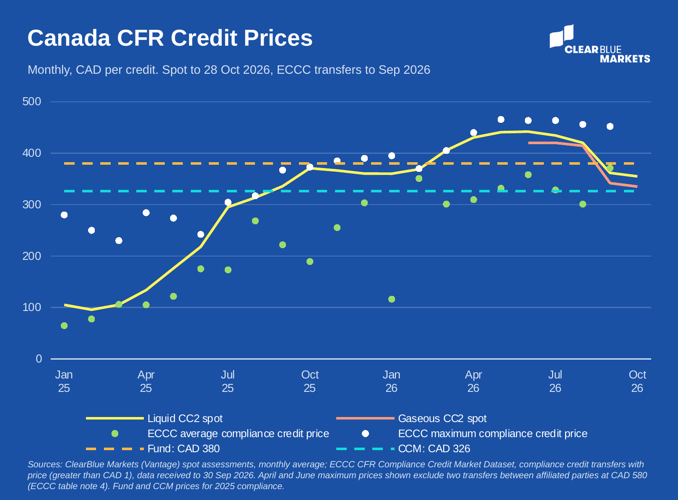
The liquid CC2 spot price (CAD 350) is CAD 101 below fair value with BC LCFS credits stacked (CAD 451) and about half the CAD 693 Canada-wide level. Spot prices are between the 2025 compliance CCM and fund prices.
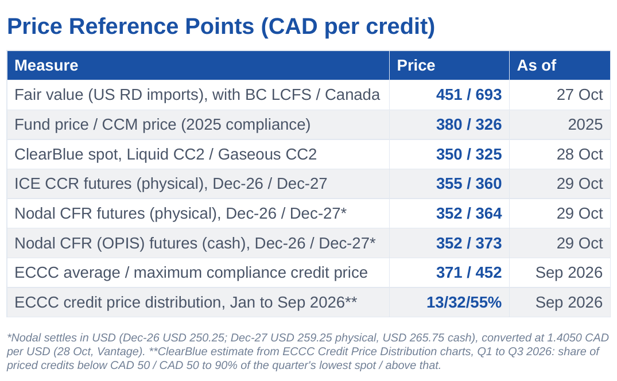
ECCC compliance credit transfers reached 5.68 Mt in July ahead of the 31 July deadline; this is 36% of 2026 YtD volume to September. Note 80% of July transfers were without a price. The September average transfer price of CAD 371 moved above spot price after running CAD 80 to 120 below it in June to August. For Q3, 75% of priced credits traded near the spot price. Prior to this, for 2026, the maximum monthly credit transfer price most closely tracked the spot market. For the YtD to September, of the priced transfers, 55% of the volume was near or above the spot price. Only 33% of volumes were priced for the first nine months of 2026. On the exchanges, the Dec-26 delivery contract settles near spot pricing. The contracts are still ramping up; for example there is no volume or open interest on ICE.
Join us on November 5 for Canada’s CFR Market: What Changes Now? A webinar about the proposed amendments, credit opportunities and the outlook for buyers and sellers.
We’ll cover how the proposal changes our 2026 price outlook, Fund usage through 2035, gaseous class credit pricing, and the timing risks for 2026 compliance. [Register]
